

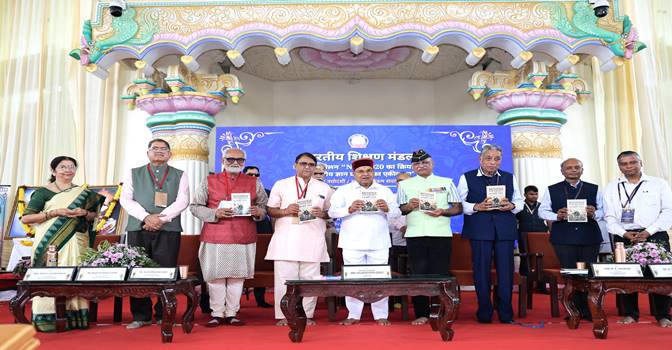
Addressing the gathering, the Governor described the Art of Living International Centre as a global hub of peace, spirituality and positive transformation, and appreciated Bharatiya Shikshan Mandal Karnataka Dakshin for bringing together eminent scholars and educationists from across the country to deliberate on the implementation of NEP-2020 and the integration of Indian Knowledge Systems (IKS).
The Governor said that India is a knowledge civilisation reconnecting with its rich intellectual heritage. Referring to ancient centres of learning such as Takshashila, Nalanda and Vikramashila, he said India's contributions in mathematics, astronomy, Ayurveda, Yoga, philosophy, architecture, agriculture and governance have made an enduring impact on human civilisation. He noted that concepts such as zero and the decimal system originated in India, while Ayurveda and Yoga continue to gain global recognition and academic validation.
Emphasising the relevance of Indian Knowledge Systems in the modern era, the Governor said that education must promote the holistic development of individuals by nurturing knowledge, values and character. Quoting the Upanishadic ideal "Sa Vidya Ya Vimuktaye" and the teachings of Swami Vivekananda, he said education should liberate individuals from ignorance and empower them to contribute meaningfully to society. He observed that education must also help build a society free from poverty, inequality and discrimination.
Highlighting the transformative vision of the National Education Policy 2020, the Governor said that the policy promotes multidisciplinary learning, skill-based education, research, innovation, critical thinking, mother tongue-based instruction and the integration of India's rich knowledge traditions with contemporary education. He said it seeks to prepare competent, creative, ethical and responsible citizens for the future.
The Governor emphasised that Indian languages are not merely mediums of communication but repositories of the nation's culture, thought and knowledge traditions. He said the emphasis on mother tongue and Indian languages under NEP-2020 is a historic step towards democratising education and making knowledge accessible to all.
Stressing the need to harmonise tradition with innovation, the Governor said that Indian Knowledge Systems and modern science must complement each other. "Modern technology gives us speed, while Indian knowledge provides direction. Science gives us power, while culture imparts wisdom," he remarked.
The Governor observed that in an era of rapid technological advancement, values such as ethics, compassion, humanity and responsibility have become even more important. He called for promoting research rooted in Indian Knowledge Systems, documenting indigenous knowledge traditions, developing quality learning resources in Indian languages, encouraging interdisciplinary research and establishing centres for integrating technology with traditional knowledge.
Highlighting India's demographic advantage, the Governor said the country's youth should be empowered through greater opportunities in research, innovation and entrepreneurship. He identified Ayurveda, health sciences, water management, agriculture, biodiversity, architecture, mathematics, astronomy and public administration as key areas where Indian Knowledge Systems offer immense potential for scientific research and global leadership.
The Governor said that the effective implementation of NEP-2020 and the meaningful integration of Indian Knowledge Systems will play a pivotal role in realising the vision of a developed, self-reliant and knowledge-based India by 2047. He expressed confidence that the deliberations at the conference would generate valuable recommendations for strengthening India's education system and advancing the nation's journey towards becoming a global knowledge leader.
The programme was attended by Dr. M.R. Jayaram, Chancellor, M.S. Ramaiah University of Applied Sciences; Dr. M.P. Shyam, President, R.V. Educational Institutions; Dr. Sachchidanand Joshi, National President, Bharatiya Shikshan Mandal; Dr. Suhas Pednekar, Working President; Prof. Praveen C. Ramamurthy, President, Karnataka Dakshin; Dr. Bharat Sharan Singh, General Secretary, along with eminent academicians, educationists, scholars and distinguished guests from across the country.


