



What is a Conjunction?
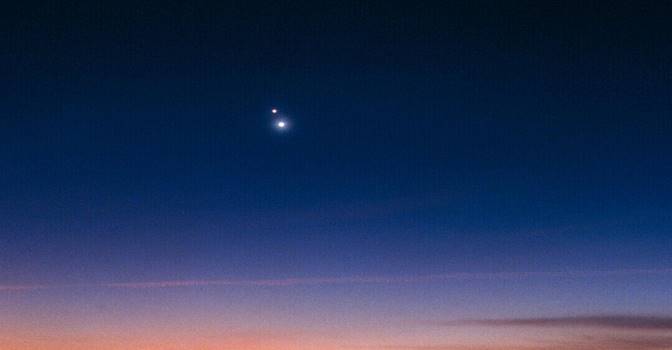
A conjunction occurs when two celestial objects appear very close together in the sky as viewed from Earth. Although Venus and Jupiter seemed nearly side by side, they were actually hundreds of millions of kilometers apart in space. The alignment was purely a line-of-sight effect caused by the planets' positions in their respective orbits around the Sun.
Why Was This Event Special?
The June 2026 conjunction was particularly remarkable because:
Venus and Jupiter are the two brightest planets visible from Earth.
The planets appeared less than 2 degrees apart in the western sky.
It was the closest visible Venus-Jupiter approach for Northern Hemisphere observers until 2028.
Astronomers described the event as a "cosmic kiss" because of the striking visual appearance of the two brilliant worlds shining together shortly after sunset.
How and When to Observe
Observers could see the conjunction approximately 45 minutes after sunset by looking toward the western horizon. No telescope was required, although binoculars enhanced the view. Venus appeared as the brighter object, while Jupiter shone nearby. Under clear skies, both planets remained visible for up to two hours after sunset.
Additional June Sky Events
The conjunction was only one highlight of a busy month for skywatchers. Mercury joined the planetary lineup during mid-June, and a rare occultation of Venus by the Moon occurred on June 17 for observers in parts of the Americas.
The Jupiter-Venus conjunction of June 2026 was a reminder of the beauty and precision of our solar system. Visible without special equipment, the event inspired amateur astronomers, photographers, and casual observers alike. Such celestial gatherings continue to captivate humanity, connecting us to the vast universe beyond our planet.


