



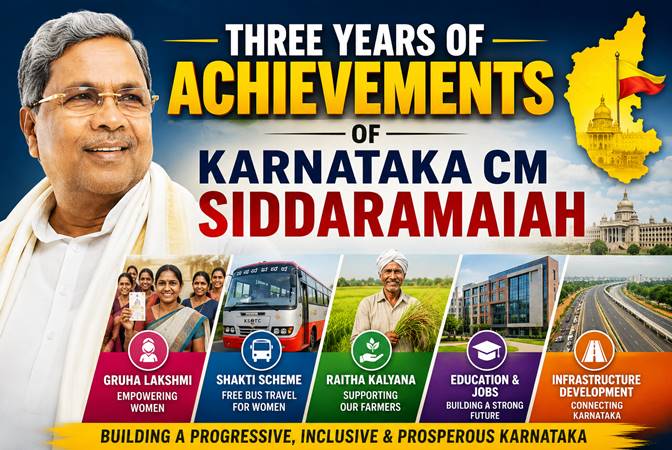
1. Five Guarantee Schemes – The Biggest Political Achievement
The Congress government’s flagship success has been implementing the five major guarantee schemes promised before the 2023 Assembly elections.
Key Schemes:
Gruha Lakshmi – ₹2,000 monthly assistance to women heads of families.
Shakti Scheme – Free bus travel for women in Karnataka government buses.
Gruha Jyothi – Free electricity up to a fixed limit.
Anna Bhagya – Additional food grain support and DBT assistance.
Yuva Nidhi – Unemployment allowance for graduates and diploma holders.
The government stated that over ₹63,000 crore was spent on these schemes by late 2024, benefiting crores of people across Karnataka.
The Shakti scheme alone became one of the most visible successes, with women using free public transport in massive numbers statewide.
2. Women Empowerment Focus
Siddaramaiah’s administration strongly targeted women-centric welfare.
Major Achievements:
Free travel increased mobility for working women, students, and rural families.
Gruha Lakshmi provided direct financial support to women heads of households.
Large allocations were made for women-oriented schemes in state budgets.
The government claimed these measures increased purchasing power and improved household spending in Karnataka.
3. Economic Growth and Budget Expansion
As Finance Minister along with being CM, Siddaramaiah presented record state budgets and highlighted Karnataka’s strong economic performance.
Economic Highlights:
Karnataka’s economy was projected to grow faster than the national average.
GSDP growth remained among the strongest in India.
Budget allocations increased significantly for welfare, infrastructure, education, and Bengaluru development.
He also defended welfare spending by arguing that guarantees boosted consumption and GST collections.
4. Social Justice and AHINDA Politics
Siddaramaiah continued focusing on his AHINDA social coalition:
Minorities
Backward Classes
Dalits
His government increased welfare spending for SC/ST communities, backward classes, and economically weaker groups.
This strengthened his image as a mass leader connected to rural and lower-income voters.
5. Transparency and Governance Measures
During the first year of government, Siddaramaiah said his administration acted against corruption and promised transparent governance.
Some notable administrative decisions included:
Ending “zero traffic” VIP movement practices.
Expanding direct benefit transfers.
Faster rollout of welfare delivery systems.
6. Infrastructure and Bengaluru Development
The government announced investments in:
Bengaluru roads and transport
Tourism projects
Rural infrastructure
Public welfare facilities
Several regional development projects were launched across Karnataka districts.
7. Political Stability and Leadership
Siddaramaiah successfully completed nearly three years while balancing internal Congress power equations with D. K. Shivakumar and maintaining party unity. He also remained one of the most influential leaders in Karnataka politics.
Criticism and Challenges
Despite achievements, the government also faced criticism:
Opposition parties accused the government of excessive borrowing to fund guarantees.
Critics claimed development spending slowed because welfare consumed large budget allocations.
Questions were raised over rising state debt and fiscal deficit.
Supporters, however, argued that welfare schemes improved people’s lives and stimulated the economy.
CONCLUSION
In three years, Siddaramaiah’s second tenure has been defined mainly by:
Massive welfare guarantees,
Women-focused schemes,
Social justice politics,
Strong budget-driven governance,
And efforts to maintain Karnataka’s economic growth.
His supporters see this period as a welfare-driven transformation of Karnataka, while critics debate the long-term financial sustainability of the model.


