



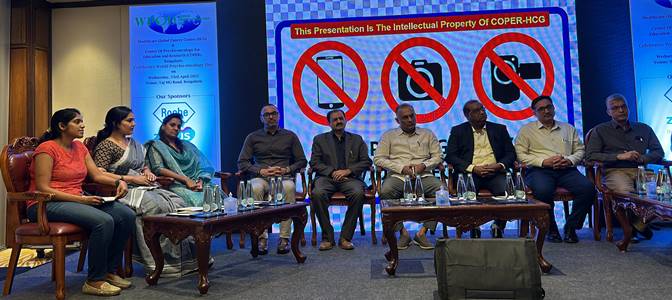
The round table brought together prominent oncologists, Psycho-oncologists, patient advocates, healthcare administrators, and policymakers to highlight the emotional and psychological dimensions of cancer care. Hon'ble Shri Dinesh Gundu Rao, Minister of Health & Family Welfare, Government of Karnataka, graced the event as the Chief Guest.
The objective of the round table was to recognize psychosocial care as an indispensable part of cancer management. Various International bodies and cancer care guidelines recognized emotional well-being as the "sixth vital sign. The discussion underscored the need to integrate routine psychosocial assessments and dedicated professional psychological intervention into every stage of cancer treatment.
Hon'ble Sri Dinesh Gundu Rao, Minister of Health & Family Welfare, Government of Karnataka, during the panel discussion, emphasized that "Psychosocial care is undoubtedly a valuable component of cancer treatment, offering crucial support to patients and their families as they navigate the emotional and mental challenges of the disease. While immediate policy integration may face administrative constraints, the need for such services is unquestionable. As we move towards a more holistic approach to healthcare, one that balances physical treatment with emotional well-being. These support systems must become part of routine care, especially for those facing life-limiting conditions. I commend the efforts of organizations driving such conversations, as they raise awareness and foster collaboration. The government remains open to suggestions and partnerships that can help integrate these services into our healthcare framework, making care more compassionate and complete."
"Psycho-oncology is not just about counseling—it's an evidence-based clinical intervention techniques driven by scientific models and principles that must be embedded into standard care," said Dr. Brindha Sitaram, Group Director –Psycho oncology service, HCG & Founder-Director, COPER, a leading voice in the field, emphasizing that emotional health significantly impacts patient outcomes.
Key Highlights from the Round Table:
Psycho-oncology to be integrated into Mainstream Care: Emotional and psychological interventions should be considered a standard and not optional in cancer treatment.
Recognition of Emotional Wellbeing as the 6th vital sign: Emotional wellbeing should be routinely screened in cancer patients alongside temperature, heart rate, respiration, pain, and blood pressure.
Training and Sensitization: Professional cancer care providers need to be sensitized and trained in identifying psychological distress and making timely referrals to psycho-oncologists.
Accessibility and Insurance Support: A call for professional psychosocial services, including substance abuse and de-addiction services to be covered under health insurance and government schemes.
Tackling Mental Health Stigma: Participants urged a cultural shift to normalize emotional wellbeing for patients and caregivers.
The discussion also highlighted findings from a study, which revealed evidence for mind-body nexus where emotional well-being and adaptive coping showed the immune system to be buoyant.
"A patient's journey is more than physical recovery; emotional resilience is just as crucial, and psycho-oncology bridges that gap," said Dr. B.S. Ajaikumar, Executive Chairman, HCG.
Dr. Brindha shared the clinical impact of behavioural and psychological interventions for children undergoing radiation therapy without sedation or anaesthesia has now become an institutional protocol at HCG. Behavioural and emotional support provided to pediatric radiation patients at HCG reduced the need for anaesthesia. With targeted psychosocial interventions, children now undergo radiation therapy awake and calm a practice that has been institutionalized at HCG.
Dr. Brindha Sitaram emphasized the alarming prevalence of psychological distress among cancer patients, citing that nearly 60% experience severe emotional challenges requiring professional intervention (Holland, 1998). In the Indian context, studies show that 52% of cancer patients suffer from moderate to severe distress, while 40% report mild distress (Sitaram et al., 2009). She also highlighted the grave mental health implications, noting that the suicide risk among cancer patients is four times higher than that of the general population. Disturbingly, India witnessed a 50% increase in cancer-related suicides between 1997 and 2020 (Shenoy et al., 2023), underlining the need for integrated psychosocial support in oncology care.
Dr. Brindha stressed that this round table marks just the beginning. The insights gathered will inform clinical training, shape institutional policies, and drive advocacy efforts to integrate psycho-oncology into national cancer care frameworks, including public healthcare schemes and insurance coverage
"No quality cancer care is complete without addressing the psychosocial needs of patients," Dr. Brindha concluded. "Seeking help from a mental health professional is not a sign of weakness, it is a mark of strength."


