

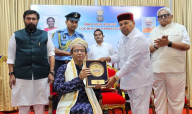

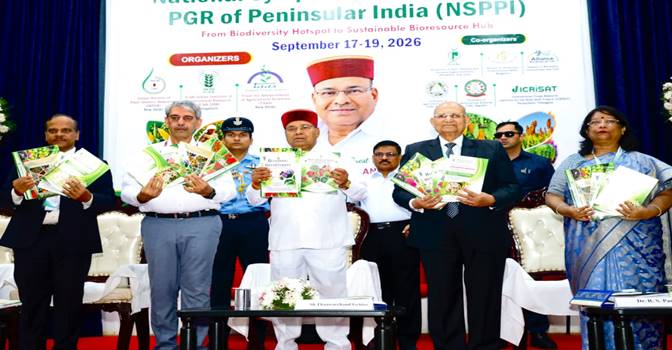
Hon'ble Governor of Karnataka Shri Thaawarchand Gehlot said that the conservation of biodiversity and the sustainable use of plant genetic resources are vital for building Viksit Bharat, and emphasised that integrating traditional knowledge, modern science and digital innovation can pave the way for a sustainable bio-economy.
Addressing the National Seminar on "Harnessing Plant Genetic Resources of Peninsular India – From Biodiversity Hotspot to Sustainable Bio-resource Hub", organized by the Indian Society of Plant Genetic Resources (ISPGR), the Indian Council of Agricultural Research (ICAR) and the ICAR-Indian Institute of Horticultural Research (IIHR) at the Dr. G.S. Randhawa Auditorium, Hesaraghatta, the Governor said the seminar had brought together scientists, researchers, students, farmers and stakeholders on a common platform to deliberate on one of the most pressing global challenges of our time -climate change, food and nutritional security, and biodiversity conservation.
Congratulating the organizers for initiating a national dialogue on the conservation, promotion and sustainable utilisation of Peninsular India's rich plant genetic resources, Shri Thaawarchand Gehlot observed that many indigenous crop varieties overlooked today could become tomorrow's climate-resilient, disease-resistant and nutrient-rich crops. "The seeds we conserve today will become the foundation of food security for future generations," he said.
Highlighting Karnataka's rich biodiversity, the Governor noted that the State is home to diverse traditional crops such as millets, sorghum, pulses, rice, oilseeds, spices and medicinal plants. He said that millets, in particular, represent an ideal combination of climate resilience and nutritional value and will play a significant role in sustainable agriculture.
He stressed that transforming Peninsular India from a biodiversity hotspot into a sustainable bio-resource hub requires a strong value chain encompassing conservation, research, innovation, value addition, entrepreneurship and greater benefits for farmers. He also underscored the importance of advanced technologies such as genomics, biotechnology, bioinformatics, artificial intelligence, remote sensing and GIS in identifying, conserving and effectively managing plant genetic resources.
Describing farmers and local communities as the true custodians of biodiversity, the Governor acknowledged the invaluable traditional knowledge preserved for generations by tribal communities such as the Toda, Kani and Soliga, whose indigenous practices have contributed significantly to conserving diverse crop and plant varieties.
Calling upon young scientists to view plant genetic resources not merely as a field of research but also as an opportunity for innovation and entrepreneurship, Shri Thaawarchand Gehlot urged universities and research institutions to strengthen the concepts of "Lab to Land" and "Land to Lab" by integrating farmers' experiences and traditional knowledge into scientific research.
The Governor expressed confidence that Bengaluru, as a leading centre for science, biotechnology and innovation, provides an ideal ecosystem for such national deliberations, and said that the discussions at the seminar would foster new research collaborations and action plans benefiting farmers across the country.
Concluding his address, he said, "Our seeds are our heritage, our biodiversity is our strength, and its sustainable utilisation is our future," and called upon all stakeholders to work collectively towards conserving and sustainably utilising India's invaluable plant genetic resources.
Among those present on the occasion were Dr. R.S. Paroda, President, Plant Genetic Resources Society of India; Dr. D.K. Yadav, Deputy Director General, ICAR; Dr. Anuradha Agrawal, General Secretary, ISPGR; Dr. Tusar Kanti Behera, Director, ICAR-IIHR; besides senior scientists, agricultural and horticultural experts, researchers, academicians and farmer representatives from various States.


