



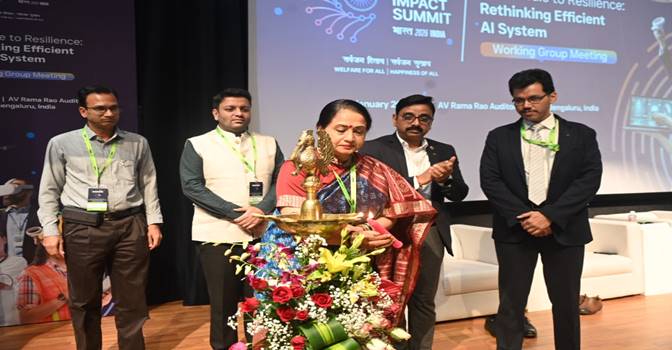
(Karnataka Information) : The Department of Personnel and Administrative Reforms (e-Governance), Government of Karnataka, convened a high-level AI Impact Pre-Summit Working Group Meeting today at the AV Rama Rao Auditorium, IISc Bengaluru. The session brought together senior government officials, industry leaders, and academic experts to chart the roadmap for Artificial Intelligence in state governance.
The meeting was graced by the Chief Secretary, Smt. Shalini Rajneesh, who emphasized Karnataka's unique position as the global hub of AI talent. She outlined a strategic vision to embed AI curriculum at the primary education level across all state schools, ensuring a future-ready workforce to meet surging global demand.
Breaking Silos: The Data Lake Initiative In her keynote, the Chief Secretary highlighted the state's shift from siloed data management to an interoperable Data Lake architecture. "Currently, datasets for farmers, students, land, and crops exist in isolation, limiting their value," she stated.
She cited a breakthrough use case in agriculture enabled by this new approach:
"By integrating crop health and soil nutrient data, we found that out of 6,000 Gram Panchayats, only 300 required specific nutrient interventions. This precision allows for the rightful allocation of fertilizers, preventing waste and optimizing resources."
Empowering Citizens by Addressing the complexity of government schemes& scheme eligibility criteria, she created a vision for Voice-Enabled AI interfaces that allow citizens to interact with government websites in natural language, bridging the digital divide while adhering to strict privacy and state regulations. She also highlighted the potential of predictive analytics in healthcare to identify causative factors for cardiac arrests and support doctors with prescriptive AI tools.
Operationalizing AI: The 4-Helix Model Shri Pankaj Kumar Pandey (IAS), Principal Secretary, DPAR (e-Gov), Govt. Of Karnataka. addressing the gathering, introduced the "Bangalore Dividend"—a 4-helix framework mapping Scale, Talent, Demography, and Desire to operationalize AI.
He highlighted a critical financial use case involving the ₹20,000 crore subsidy provided by the Finance Department for 35 lakh irrigation pump sets. "By leveraging AI to map crop data against water requirements, we can optimize water consumption, reduce soil erosion, and significantly rationalize the subsidy burden," he explained.
Karnataka AI Cell (KAIC): Innovation in Action Shri Pandey detailed the institutionalization of the Karnataka AI Cell (KAIC), built on four pillars: Advisory, Solution Development, Collaboration, and Capacity Building. He mentioned about stellar AI products already revolutionizing administrative reforms:
• Kartavya: An AI-based attendance management system covering over 1.5 lakh government officials.
• Muzzle Print Initiative: A unique biometric identifier for cattle to ensure the rightful disbursement of benefits to farmers.
• Student Attendance System: Covering over 50 lakh school students.
• Saaramsha: An AI information extraction tool (currently under pilot) that summarizes Government Orders, notifications, and circulars for rapid decision-making.
Future of Energy The session concluded with insights from Shri Shashank Mishra (IAS), Joint Secretary, Ministry of Power, GoI who mentioned the India Energy Stack and the Unified Energy Interface (UEI), a peer-to-peer trading platform set to transform the energy sector. He emphasized that the working group is laser-focused on Innovation, Resilience, and Efficiency, designing AI systems that deliver maximum societal benefits and grid stability.
National Vision: The Road to Delhi Concluding the session, Shri Abhishek Aggarwal, Senior Scientist, MeitY, presented the National Vision leading up to the India AI Impact Summit, scheduled to be held in New Delhi from February 19th–20th, 2026.
He outlined the summit's guiding philosophy, which is anchored in the "3 Sutras" (People, Planet, and Progress) and operationalized through "7 Chakras"—thematic working groups designed to ensure AI serves humanity, safeguards the environment, and drives inclusive growth across the nation.
Call for Collaboration: The Government of Karnataka invites GCCs, IT agencies, and startups to collaborate on building scalable, citizen-centric AI applications for social good. "It is Karnataka's time to serve and shine," the Chief Secretary concluded.


