

All the speakers, from industry, government and academia, were of the opinion that the keys to the country getting ahead, included the success of the ‘Make in India’ initiative, collaboration between all stakeholders, financial and social inclusion, and better ease of doing business with a focus on developing the country as a manufacturing hub.
“India is an evolving economy and the contribution of the automotive industry in the country’s economy is immense. India is now the world’s largest two-wheeler market and world’s fifth largest automotive market,” said Malo Le Masson, Head – Global Product & Planning, Hero MotoCorp Ltd., in his keynote address at the conclave.
Themed around ‘India Inc. Shifting Gears’, the conclave had keynote speaker sessions, panel discussions, industry talks and quizzes.
Malo Le Masson spoke, at length, about the ‘Make in India’ initiative in the context of the automotive industry, about regulations and future investments. “Make in India is a huge initiative for the automotive and auto components sector. Sometimes, in India, we do not immediately see the changes which are happening, like policies, tax reforms, etc. But, India is making an impact on the world map. We are good at manufacturing at competitive costs – in fact Indian manufacturing costs are among the lowest. India is among the largest auto markets worldwide. With BSLV, India’s technology will be at par with the world. India has the potential to emerge as a manufacturing hub,” he said.
Pointing out that India had to now ‘shift gears’, Le Masson recommended a few measures which could be adopted for further growth of the sector. “The Government’s vision should be to try to see if we can change the curve of supply and demand. To make the vision into reality, we need to look into elements like incentives, slow charges, fast charges, etc. Another area of focus should be to make vehicles cleaner and bring in greener forms of energy. India is in a transitional phase. But it is all about setting in place clear boundaries where all can operate. Performance/competition should be focused on so that investors, consumers and all other stakeholders can benefit,” he said.
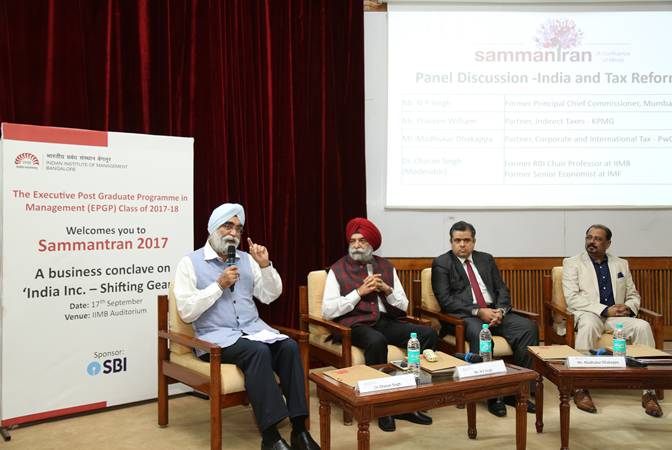
The conclave featured a panel discussion on 'India & Tax Reforms', featuring N P Singh, Former Chief Commissioner of Income Tax, Mumbai; Madhukar Dhakappa, Partner – Corporate & International Tax, PwC India, and Praveen William, Partner – Indirect Taxes, KPMG. The discussion was moderated by Professor Charan Singh, Visiting Faculty from the Economics & Social Sciences area of IIM Bangalore.
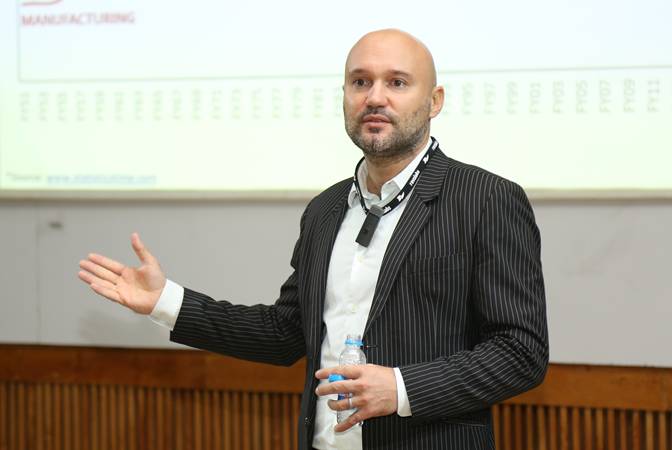
The Industry Talk was delivered by Kamal Bali, Managing Director & President, Volvo India. Describing India as “a land of severe contrasts”, he said one had to combat several legacy challenges like poverty, infrastructure, inequity, inefficient and high logistics cost, inadequate educational and vocational skills, need for new jobs, maternal and child mortality, etc.
Listing measures to be adopted to steer new India to higher growth, he said: “Financial and social inclusion is a key factor. There should be balance between responsibility to create jobs and new technology, more focus on creating pool of skills and development of new jobs as well as vocational skills, greater sustainability focus, bringing in culture and mind-set of innovation and experimentation, attracting right talent, need for new competencies, data privacy, collaboration between all stakeholders, new mind-set to deal with disruption, focus on public policy and legislation, marriage between future culture and strategy,” he said, observing that India Inc. should shift from creating products to creating brands.
“Mega trends that will reshape the future are digitalization, rapid urbanization, growing sustainability needs and geopolitical challenges. India must push manufacturing and thus create more jobs. Make in India has the potential to ignite a virtuous cycle of demand growth. Economic fundamentals are improving. Now is the time to be in India. You are the ones to take India to the next level. Strive to continue to create customer value,” he told the young managers.


